- Torremolinos launched a €2.21 million resurfacing programme on 4 September 2026 covering 67,069.55 m² of roads across the municipality. The council says road renewal will now receive an annual budget allocation rather than being treated as an occasional intervention.
- The €3.6 million redevelopment of Plaza La Nogalera opened in July after a 19-month programme. The new centrepiece adds shaded seating, Mediterranean planting, water features, step-free access and a more pedestrian-first layout above the C-1 railway infrastructure.
- La Carihuela is receiving smaller-scale street regeneration too. A €500,323 project on Calle Niña de Oro creates a single-level pedestrian environment, buries visible cabling and adds separate stormwater drainage and a vertical garden.
- Torremolinos asking prices reached €4,229/m² in August 2026, up 9.9% year on year and a new high in Idealista's current series. Playamar stood at €5,309/m² and El Bajondillo at €5,138/m², while the town centre averaged €3,838/m².
- The latest publicly reported municipal-register figure put Torremolinos at 74,289 residents, including 18,003 foreign nationals — 24.2% of the population — representing 121 nationalities. The town is functioning increasingly as a year-round residential base, not only a holiday resort.
- Bottom line: Torremolinos is becoming more interesting to property buyers because the old advantages — beach, airport and railway — are now being reinforced by a visible programme of public-realm renewal. The opportunity is not one homogeneous market: Playamar, Bajondillo, La Carihuela, Montemar and the centre are pricing very different ownership experiences.
On 4 September, Torremolinos put 67,069.55 square metres of road surface into a single municipal works programme. As property-market headlines go, resurfacing is not glamorous. There is no infinity pool, no sea-view render and no promise of a new landmark. Yet the €2.21 million project says something useful about where Torremolinos is in 2026: a town built around mass tourism is spending serious money on the ordinary public realm that makes a place easier to live in every day.
That work sits beside a much more visible €3.6 million reconstruction of Plaza La Nogalera in the centre, pedestrian improvements in La Carihuela, façade-renovation incentives, new shaded areas and a municipal budget of more than €120 million. None of those projects alone makes a property more valuable. Together, however, they change the question buyers should ask about Torremolinos. The town is no longer interesting simply because it is close to Málaga Airport and has a long beach. It is interesting because several parts of the municipality are being reworked for a more permanent, pedestrian and year-round way of living.
The property data show why that matters. Torremolinos reached a new asking-price high of €4,229/m² in August 2026, but that municipal average hides one of the widest internal spreads on the western Costa del Sol. Playamar is above €5,300/m²; El Pinar-Palacio de Congresos is below €2,700/m². A buyer is not really choosing “Torremolinos”. They are choosing a version of Torremolinos — beach, town centre, rail-connected residential district or established hillside neighbourhood — and the public realm increasingly helps explain the price.
A Resort Town Is Spending More Like a Residential City
Torremolinos' 2026 municipal budget is €120.59 million, 2.27% higher than in 2025. The significance is not the percentage increase by itself; it is where some of the money is going. The latest resurfacing tender covers neighbourhoods across the municipality, including one of the approaches from the MA-20, with a five-month execution period. The council has also said that road-surface renewal will become a recurring annual budget item.
The demographic shift makes those investments more than tourism cosmetics. The latest municipal-register figure publicly reported in September 2025 put the population at 74,289 residents, up from 70,933 in 2024. Of that total, 18,003 were foreign nationals, or 24.2%, across 121 nationalities. Torremolinos can still feel intensely seasonal on an August afternoon, but its resident base is large and international enough to support year-round shops, restaurants, transport and services.
La Nogalera Is the Centre's Proof of Concept
If the road programme is the unphotogenic side of regeneration, Plaza La Nogalera is the opposite. The central square reopened in July 2026 after a project that began in October 2024 and ultimately cost about €3.6 million. The final budget was roughly €600,000 above the earlier figure — close to a 20% increase — after engineers encountered constraints including a medium-voltage line and the railway infrastructure immediately beneath the site.
The finished design is more instructive than the overrun. The square now uses shaded seating, Mediterranean planting, water features, pergolas, curved routes and step-free access. Adjacent streets were incorporated into the intervention, and the works specifically addressed architectural barriers. In a hot coastal town, shade and accessibility are not decorative extras. They determine whether a central public space works at midday in July, for an older resident, for a wheelchair user or for a family with a pushchair.
For a buyer considering the centre, this is the opportunity and the trade-off in one place. The centre offers the strongest concentration of shops, transport and everyday services, but it is denser and more urban than Playamar or La Carihuela. The regeneration does not turn central Torremolinos into a low-density resort. It makes the urban proposition more coherent.
La Carihuela Shows How Regeneration Reaches the Beach
The same idea is visible at a smaller scale in La Carihuela. In March, Torremolinos awarded a €500,323 contract for Calle Niña de Oro, with a four-month programme. The street is being reworked as a single-level pedestrian-priority environment with controlled vehicle access, a vertical garden and new paving. More importantly, the project buries telecommunications, low-voltage electricity and lighting cables, renews drinking-water pipes and adds a separate stormwater system.
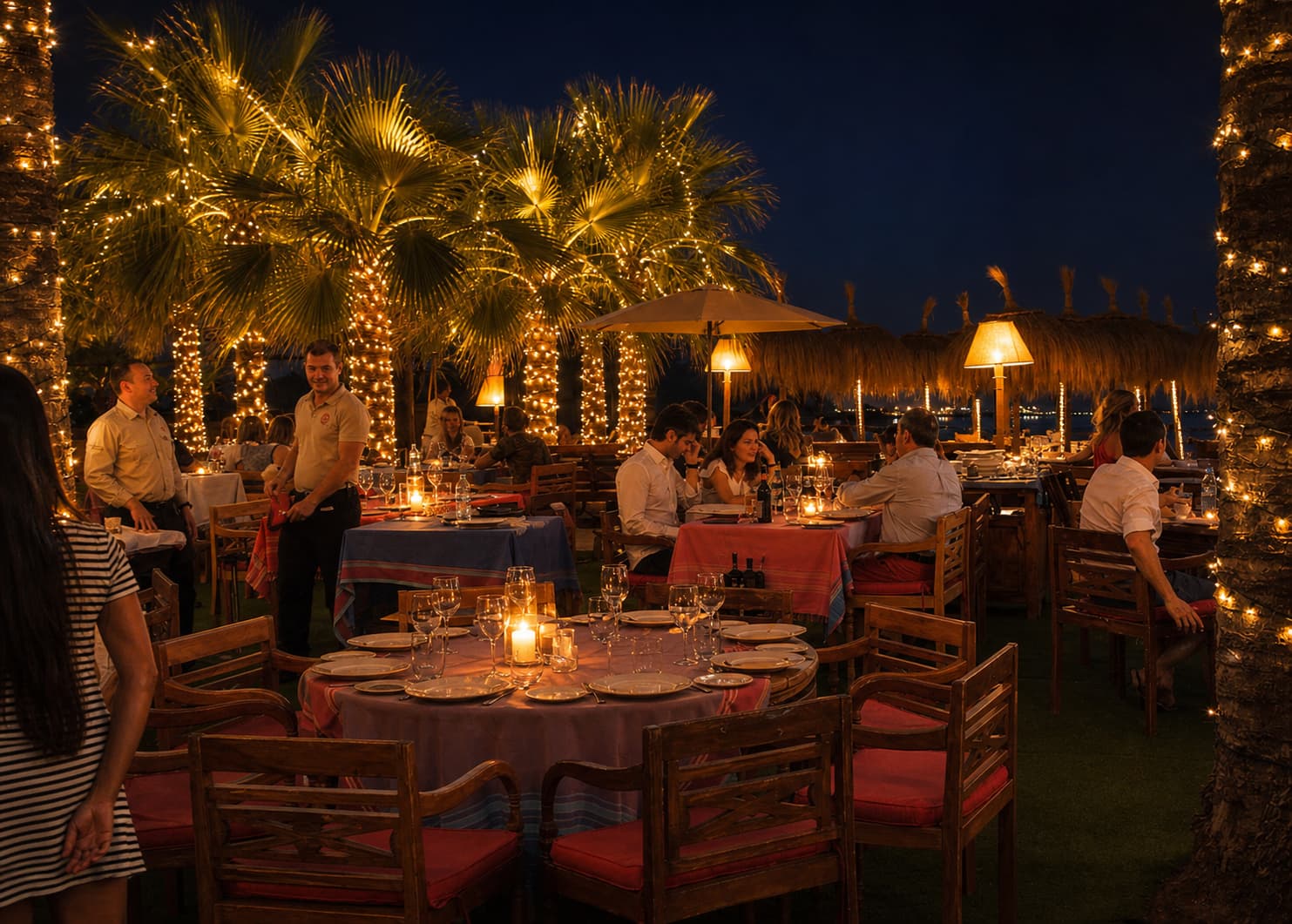
That is exactly the kind of intervention established coastal districts need. La Carihuela's appeal comes from something new construction cannot manufacture overnight: a former fishing quarter, restaurants close to the sand and a promenade that forms part of an almost seven-kilometre coastline. The municipality's four principal beaches — La Carihuela, El Bajondillo, Playamar and Los Álamos — are serviced as one continuous coastal asset, with the 2026–27 beach-safety contract alone worth €1.1 million and providing 23 lifeguards a day across 11 towers during the principal operating period.
Torremolinos is also using incentives to pull private buildings into that process. A new local framework approved in principle in June allows grants of up to 70% of eligible works for façades, roofs and areas visible from public roads, while technical fees can be subsidised up to 100% under the scheme. Buyers should not assume a particular community will receive funding, but the policy direction is clear: the council wants the improvement of private buildings to reinforce the public works outside them.
The Price Map Says There Is More Than One Torremolinos
Idealista's August 2026 asking-price index puts Torremolinos at €4,229/m², 9.9% higher than a year earlier and the highest municipal figure in its current series. That sounds like a simple market story until the neighbourhoods are separated. The gap between Playamar and El Pinar-Palacio de Congresos is €2,633/m² — a 98% difference between the highest and lowest figures in the current district table.
| Torremolinos area | Aug 2026 asking price | YoY change | Buyer reading |
|---|---|---|---|
| Playamar | €5,309/m² | +18.6% | Premium beachfront/near-beach market with modern apartment demand |
| El Bajondillo | €5,138/m² | +25.1% | Central beach access; strongest annual rise in the current area table |
| La Carihuela - Los Nidos | €4,831/m² | +8.1% | Established seafront lifestyle and restaurant district |
| Torremolinos overall | €4,229/m² | +9.9% | Useful benchmark, but hides large micro-location differences |
| Centro | €3,838/m² | +9.0% | Urban services and rail at a lower average than the beachfront |
| El Pinar - Palacio de Congresos | €2,676/m² | -0.2% | Lower entry €/m², but a different relationship with beach and centre |
The most striking figures are on the beach. Playamar reached €5,309/m², up 18.6% in a year, while El Bajondillo reached €5,138/m² after a 25.1% annual rise. La Carihuela-Los Nidos was lower at €4,831/m² but still 8.1% higher year on year. Those are asking prices, so they should not be read as achieved sale prices or as proof that every apartment in those districts has appreciated by the headline percentage.
What the figures do show is that buyers are placing a substantial premium on the parts of Torremolinos where the beach and daily life overlap most conveniently. El Bajondillo combines the seafront with relatively quick access up towards the centre. Playamar has wider modern avenues and a concentration of larger apartment complexes. La Carihuela has the strongest old-neighbourhood identity and immediate restaurant life. The centre is cheaper per square metre, but it wins on services and transport rather than a front-line address.
Five Kilometres From the Airport Changes the Ownership Pattern
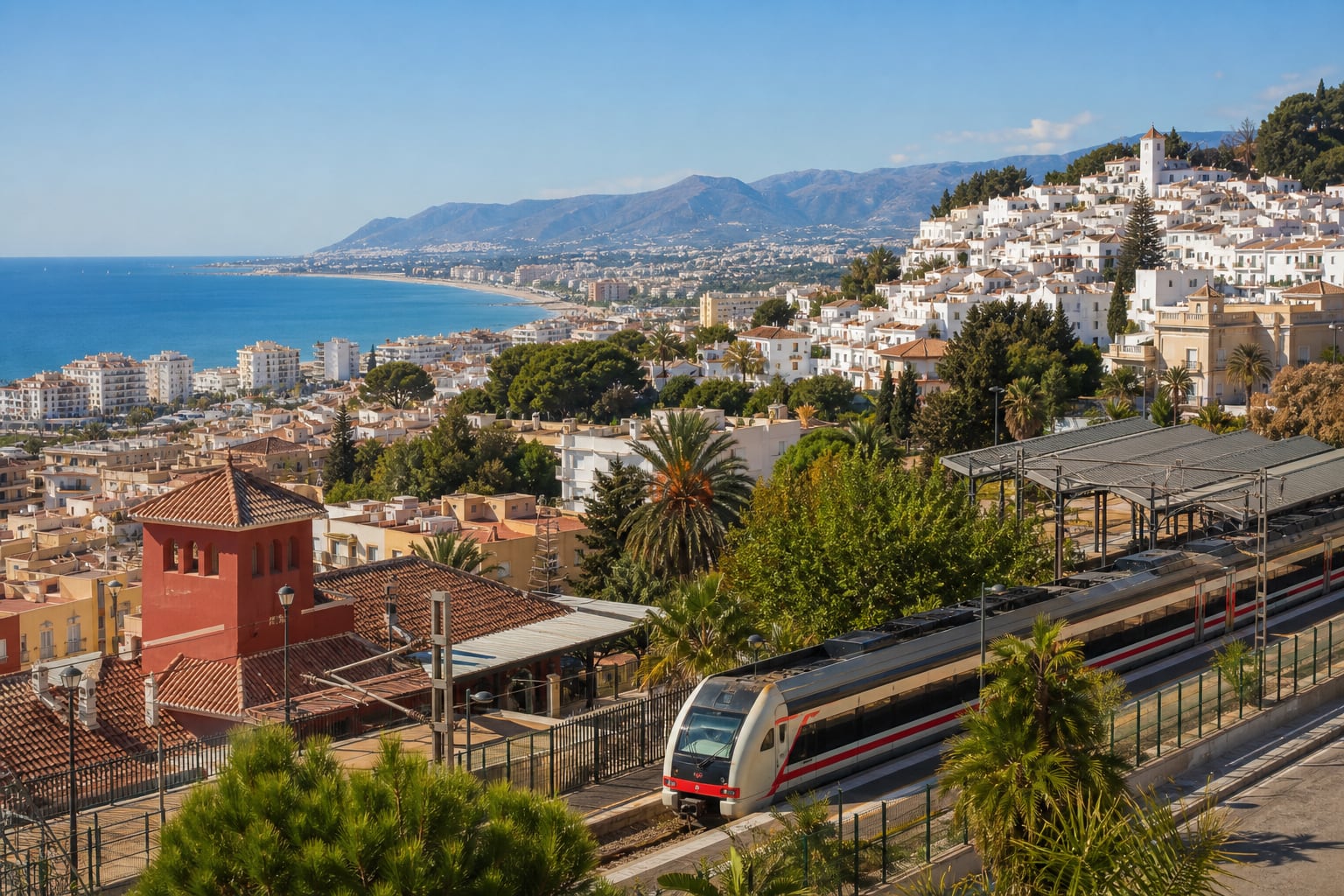
Torremolinos' transport advantage is unusually difficult for newer resorts to copy. The municipality's official tourism service places it about five kilometres from Málaga-Costa del Sol Airport and estimates the local-train journey at roughly 10 to 15 minutes, depending on the station. Málaga city centre is around 20 minutes by the same local network.
Renfe's C-1 map shows the line running through Los Álamos, La Colina, Torremolinos, Montemar Alto and El Pinillo before continuing west towards Benalmádena and Fuengirola. That matters because the transport benefit is not confined to one central station. Different residential districts can access the same airport-city-coast spine, even if the walk to the nearest platform varies significantly by property.
We recently looked at the wider effect of air connectivity in our analysis of how the Costa del Sol second home became a weekend home. Torremolinos is the most literal expression of that argument. A buyer can keep the airport transfer short enough that a three-night stay does not feel like an expedition, and in several districts the car becomes optional rather than compulsory.
Airport, railway and road proximity also make exact positioning important. Noise exposure varies by building and orientation, so buyers should view at different times rather than assume that every property receives the same benefit — or the same nuisance — from the transport network.
What Today's New-Build Choice Looks Like
Torremolinos is not currently a giant new-build market in Domosmar's catalogue. On 14 September 2026, our live Torremolinos property collection showed two available new-build developments, with advertised entry prices from €385,000. One is indexed to Playamar and the other to La Carihuela. By comparison, Domosmar's full Costa del Sol database contained 320 available developments with a median advertised development entry price of approximately €642,500.
Those figures describe Domosmar's current stock, not total market supply. They do show that buyers seeking newly delivered product in Torremolinos have less catalogue depth than in larger growth corridors such as Estepona or Mijas, making the individual micro-location especially important.
Our recent analysis of new-build versus resale price growth made the same wider point: category labels do not replace micro-location. Torremolinos may be one of the clearest places to see it, because a few kilometres can move the buyer from a new beachfront development to a dense railway-connected centre or a traditional promenade neighbourhood.
The Buyer Question Is Which Torremolinos You Want
The regeneration programme makes Torremolinos more convincing, but it does not erase the differences between its districts. A buyer who wants to walk out for seafood and spend most of the day near the promenade may accept La Carihuela's tighter streets and older building stock. A buyer who values newer residential complexes, a broader seafront and easier airport-side access may prefer Playamar or Los Álamos. A buyer who wants train, shops and year-round urban life can make a strong case for the centre without paying the beach premium.
The public investment improves all three propositions in different ways. La Nogalera makes the centre more comfortable and legible. La Carihuela's street works modernise infrastructure without trying to turn the neighbourhood into a new resort. Road renewal, façade incentives and beach services deal with the less glamorous maintenance that older destinations need if they are to compete with master-planned developments further along the coast.
That is why Torremolinos deserves a fresh look from buyers who last formed an opinion of the town years ago. The strongest case is not that regeneration will automatically produce a particular capital gain; no serious buyer should price in a guaranteed uplift from a square or a resurfaced avenue. The case is that the municipality's infrastructure advantages are becoming easier to use, while the beachfront and centre remain close enough to compare within one viewing day.
For a Costa del Sol second home, that combination can be unusually practical: almost seven kilometres of coast, a 10–15 minute train connection to the airport, a resident population approaching 75,000 and a property market that still offers materially different price bands. The 67,070 m² road programme is not the reason to buy. It is a useful sign that the town is investing in the parts of ownership you notice after the brochure has been put away.
Sources & Data Notes
Property figures use Idealista's August 2026 asking-price index and should not be confused with completed transaction prices; Idealista notes a methodology update from July 2026. Public-works figures use contemporary Torremolinos reporting on the September road-resurfacing tender, the July opening of Plaza La Nogalera and the March La Carihuela street project. The 74,289 population figure is the latest municipal-register total publicly reported in September 2025, not an estimate for September 2026. Airport and rail-access figures use Torremolinos' official tourism information and Renfe's current C-1 map. Domosmar inventory figures are a live catalogue snapshot on 14 September 2026.
- SUR in English — Torremolinos €2.2m / 67,069.55 m² resurfacing programme, 4 September 2026
- SUR in English — opening of the redeveloped Plaza La Nogalera, 24 July 2026
- SUR in English — Calle Niña de Oro / La Carihuela regeneration project, 6 March 2026
- Idealista — Torremolinos asking-price index, August 2026
- Torremolinos official tourism service — airport and Málaga transport connections
- Renfe — Málaga Cercanías C-1 network map
If Torremolinos' combination of beach access, airport proximity and year-round services fits your brief, browse the current Torremolinos properties, including the live selections in Playamar and La Carihuela. For a shortlist that compares the walk to the beach, railway access, aircraft and road exposure, orientation and the quality of the surrounding public realm — not just the asking price — contact Domosmar.